Admiration Is a Door, Not a Destination: Knowing When You've Stopped Learning and Started Disappearing
There's a particular kind of creative spiral that's almost impossible to catch in real time. It doesn't announce itself. It doesn't feel like a warning. It feels like enthusiasm.
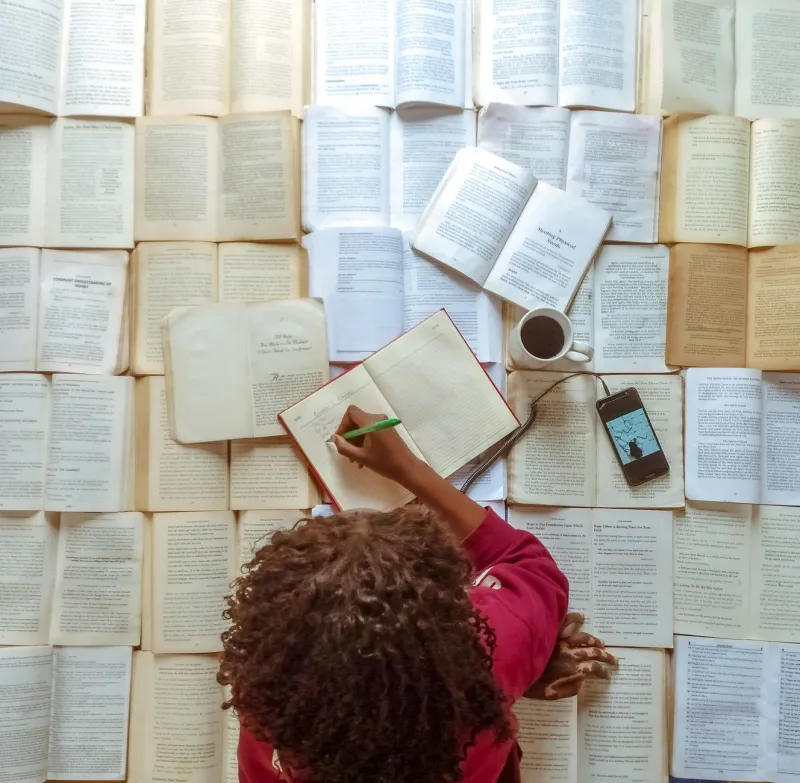
You find a creator you love — a writer, a photographer, a podcaster, whoever — and something in their work genuinely moves you. You study them. You take notes. You reverse-engineer their cadence, their structure, their visual choices. You tell yourself this is research. You tell yourself this is how craft gets built. And honestly? For a while, you're not wrong.
But there's a line somewhere in that process. A line between learning from and becoming. And by the time most of us notice we've crossed it, we're so deep in someone else's aesthetic that we can barely remember what our own voice sounded like.
The Disguise That Actually Works
Here's what makes this particular trap so effective: self-doubt is a master of costumes. When you're not confident in your own work — when you're in that tender, uncertain middle place where you know you want to create but you're not sure if what you're making is any good — admiration becomes a very convenient hiding spot.
You don't have to decide what you think is interesting if you're busy figuring out what they would do. You don't have to sit with the discomfort of your own half-formed ideas if you have a template to follow. Studying someone else's process can feel like productivity when it's actually avoidance wearing a really convincing outfit.
Psychologists call something similar "identity foreclosure" — when you adopt an identity handed to you rather than developing one through genuine exploration. Creatively, it shows up as latching onto another creator's established voice before you've done the messy, uncomfortable work of discovering your own.
And the cruelest part? The work you produce during this phase can actually be decent. Technically competent. Even well-received. Which makes it harder, not easier, to notice that something important is missing.
Two Questions Worth Sitting With
When you're trying to figure out which side of that line you're on, there are two questions I keep coming back to.
The first one is: what are you taking away?
When you study a creator you admire, are you extracting principles or products? There's a meaningful difference. Principles are transferable — the idea that tension creates engagement, that specificity is more powerful than generality, that pacing can be used as an emotional tool. These are things you can absorb and then apply through the filter of your own perspective.
Products are the specific outputs of someone else's perspective. Their exact sentence rhythm. Their color palette. Their particular way of framing an intro. When you're copying products instead of learning principles, you're essentially wearing someone else's fingerprints.
The second question is: does your work still surprise you?
This one sounds a little soft but it's actually pretty diagnostic. Your own authentic creative voice has an element of unpredictability to it — you don't always know where it's going to go. When you're genuinely working from your own instincts, you'll sometimes land somewhere unexpected. You'll write a line that makes you laugh, or make a compositional choice that you couldn't have planned.
If your work has stopped surprising you — if it just feels like executing a familiar formula — that's worth paying attention to. It might mean you've been following someone else's map for long enough that you've forgotten how to navigate without one.
The Pivot That Doesn't Require Burning Everything Down
Noticing that you've drifted is uncomfortable. There's often a little shame attached to it, a feeling of I should have known better or I can't believe I've been doing this. Try not to let that shame convince you that the answer is to dramatically reject everything you've been influenced by.
Influence isn't the problem. Every single creator you admire was shaped by the creators they admired. The goal isn't to arrive at some pure, uninfluenced state — that's not a real place. The goal is to metabolize your influences rather than reproduce them.
A useful reentry exercise: go back to something you made before you found the creator you've been studying. Before the influence got heavy. Look at what was present in that older work — not to replicate it, but to remember what you were reaching for. What were you interested in? What problems were you trying to solve? What did you care about that had nothing to do with anyone else's aesthetic?
Then take one small project — genuinely small, low stakes — and make it without looking at any reference material from the people you've been studying. Not forever. Just once. See what comes out when you're not navigating by someone else's north star.
What Real Inspiration Actually Feels Like
Genuine inspiration has a particular texture that's worth recognizing when you find it. It makes you want to make your thing, not a version of their thing. It gives you energy rather than anxiety. It opens up questions rather than providing answers.
When I encounter work that truly inspires me, I usually walk away thinking about something in my own life or perspective that I haven't explored yet. The other creator's work acted as a key that unlocked something in me — not a blueprint I'm supposed to follow.
When I'm in the comparison trap disguised as inspiration, I walk away feeling like I need to catch up. Like I'm behind. Like I need to understand exactly how they did what they did so I can figure out how to do it too. That's not inspiration. That's anxiety wearing inspiration's jacket.
The difference in how your body feels after those two experiences is real data. Pay attention to it.
The Work Only You Can Make
Here's what I genuinely believe: there is creative territory that only you can cover. Not because you're uniquely talented in some grand cosmic sense, but because the specific combination of your experiences, your obsessions, your weird little fixations, your particular way of seeing — that combination belongs only to you.
When you spend too long in someone else's lane, that territory goes unmapped. The work that could only come from you doesn't get made. And the world — your corner of it, anyway — is a little smaller for it.
Admiration is a door. Walk through it, take what's useful, and keep moving toward your own work. That's the whole job.