You Keep Grieving a Version of Yourself Who Wasn't Even That Happy
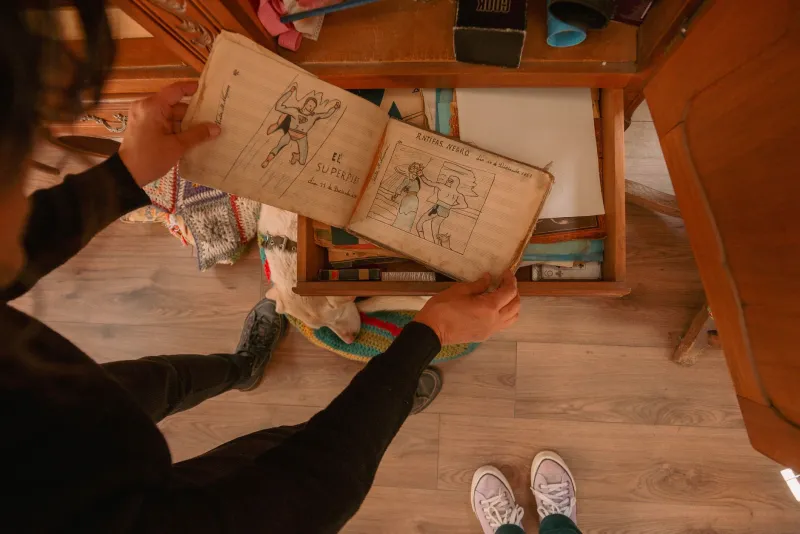
I found an old sketchbook a few months ago. One of those beat-up, coffee-stained ones from probably a decade back, stuffed in a box I'd been dragging from apartment to apartment without ever opening. I sat on my floor and flipped through it, and something uncomfortable happened: I felt jealous. Not nostalgic. Not wistful. Straight-up jealous—of myself.
The lines were looser. The ideas were weirder. There was this fearless, slightly chaotic energy in every page that I couldn't quite locate in my current work. And before I even realized what I was doing, I'd built a whole story in my head: I used to be better. I used to be freer. Something got lost.
If you've ever done a version of this—rewatched an old video, reread early writing, listened to a song you made in your twenties—you probably know the feeling I'm describing. It's the comparison trap's uglier, more personal cousin. Because at least when you're jealous of someone else's success, you can eventually talk yourself down. You can remind yourself you don't know their full story. You can create some distance.
But when the person you're jealous of is you? There's nowhere to hide.
Why We Romanticize Our Own History
Here's the thing about memory: it's an editor, not a documentarian. It cuts the boring parts, softens the hard ones, and leaves you with a highlight reel that never quite happened the way you remember it.
When you look back at who you were creatively at 22, or 27, or whenever your personal golden age supposedly was, you're not actually seeing that person clearly. You're seeing them through the filter of everything that's happened since. You've forgotten the self-doubt. The work that didn't land. The nights you stayed up convinced you had no idea what you were doing. You've edited all of that out, and what's left is this luminous, unfettered version of yourself who apparently had it all figured out.
She didn't. She really didn't. But she looks amazing from here.
This is what psychologists sometimes call rosy retrospection—the tendency to remember past events more positively than we experienced them in real time. It's not a character flaw. It's just how human brains work. But for creators, it can be genuinely destabilizing, because it makes the present feel like a step backward even when it isn't.
What This Nostalgia Is Actually Costing You
Let's be honest about what happens when you spend real mental energy grieving a past creative self. You start second-guessing your current instincts. You try to recreate something instead of discovering something new. You develop this low-grade anxiety that you've already peaked—which, if you let it, will become a self-fulfilling prophecy.
I've watched this happen to creators I genuinely admire. Someone puts out a piece of work that gets a lot of attention, and instead of building from that moment, they spend the next two years trying to replicate it. They're chasing a version of themselves rather than becoming a new one. The work gets tighter, more calculated, and somehow less alive—which only deepens the feeling that the magic is gone.
The magic isn't gone. It's just being suffocated by the weight of your own mythology.
And here's the part that stings a little: that old work you're romanticizing? It was probably made by someone who wasn't looking backward. She was just making things. She wasn't worried about whether it matched her previous work because there wasn't much previous work to match. The freedom you miss wasn't a personality trait. It was a circumstance. And you can recreate the conditions for it, even now.
Separating What Was Real from What You've Invented
Try this. Next time you find yourself in that nostalgic spiral, get specific. Not vague-specific, like I was so creative back then. Actually specific. Write down three concrete things that were genuinely better about that creative period. Then write down three things that were genuinely harder.
Most people, when they do this honestly, find that the list is a lot more balanced than the fantasy suggested. Yes, maybe you had more unstructured time. But you also had less skill, fewer resources, and probably a lot more fear of being seen. Maybe you published more freely because you had fewer people watching—and now that you have an audience, the stakes feel higher. That's not regression. That's growth wearing an uncomfortable costume.
The goal isn't to dismiss what was good about that earlier version of yourself. It's to stop treating her like a destination.
She's Not Coming Back—And That's Not the Bad News
I want to say something that might feel counterintuitive: you are not supposed to be who you were. That person made sense for that moment. She served her purpose beautifully. But you have outgrown her, and outgrowing something is not the same as losing it.
Every skill you've built since then, every hard conversation you've had about your own work, every project that failed and taught you something—all of that lives in you now. It changed how you see. It changed what you're capable of. The fact that your current work looks different from your old work isn't evidence of decline. It's evidence of movement.
The creators who keep making interesting work over the long haul aren't the ones who successfully preserve their early energy. They're the ones who let each phase of themselves be complete, and then keep going.
Moving Forward Without Abandoning What You Love
None of this means you can't learn from your past work. Go back to it. Study it. Notice what it was doing that your current work isn't. That's a useful exercise. But there's a difference between learning from your history and being haunted by it.
If looking at old work makes you want to try something new, great. If it makes you feel like a lesser version of yourself, close the sketchbook. Seriously. You don't owe that feeling your afternoon.
The version of you sitting here right now—the one who's been through more, seen more, made more mistakes, and somehow kept going—she deserves the same grace you keep extending to your past self. Maybe more.
She's not a downgrade. She's what came next.
And what comes next is still being written.